
Kassandra TM9 complex of radio monitoring and digital signal analysis
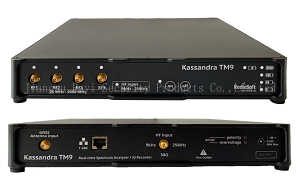
Kassandra TM9 complex of radio monitoring and digital signal analysis
Purpose
Kassandra TM9 complex of radio monitoring and digital signal analysis is designed for round-the-clock,continuous radio monitoring of the object and detection of unauthorized radio transmissions, including
those with complex concealment algorithms, as well as for the analysis of digital communication standards.
The complex can be used as an IQ recorder with a recording bandwidth of up to 40 MHz.
Characteristics
A complex with a built-in RPU with an ADC unit with control from a PC via LAN 1 GbE. The complex
consists of a monoblock with a height of 50mm. and it can be installed both in a 19-inch rack and
freely placed in various installation locations (underfloor space, wall cabinets, etc.). Round-the-clock
operation mode.An autonomous power supply system can be installed in the monoblock for at least
5 hours of operation. There is a 4-channel antenna switch (25-9000 MHz).
All complexes with builtin batteries can charge the batteries during operation. The type of battery
used(LiFePO4) allows the device to be used in extreme operating conditions. Operating temperatures from -20
to +50 degrees Celsius. Storage temperatures from -30 to +60. They are as safe as possible to use – they do not ignite and do not explode, even if they are depressurized. The extended input voltage range (9-36 volts) allows the complex to be used on various infrastructure and modes of transport.
Unique features
- Maintaining high speed with narrow bandwidth
- Use as a manual amplitude direction finder (if directional antennas with an electronic compass
and the RT-Geo software option are included in the package)
- Four RF inputs of the same type, allowing you to implement various methods of comparative
anal- ysis or connect antennas of different ranges simultaneously
Parameter | Value |
Frequence range | 9 kHz-9 GHz (in the range from 25 MHz to 9 GHz, a 4-channel switch is used) |
Purpose | High-speed radio monitoring and digital signal analysis complex/IQ recorder |
Maximum tuning speed Depends on the performance of the computer | More than 200 GHz/sec (RBW 218 kHz) 70 GHz/sec (RBW 13 kHz) (in the range of 25-9000 MHz) |
Average self-noise level, without preamp (DANL) | -158 dBm (1Hz) |
Dynamic range at the compression point of 1 dB (without ATT) | Not less than 120 dB |
Real-time analysis band | 0.256…40 MHz |
IQ recording band | 12 MHz (no IQ recording time limit) 40 MHz (at least 2 minutes with 1 Gb LAN inter- face) |
Maximum frequency resolution | 1 Hz |
Types of software demodulators | АМ, FM, USB, LSB, TETRA, APCO-P25, DMR, dPMR AnalogTV ( PAL/SECAM/NTSC), DVB-T2 (fragment up to 8 seconds) |
Types of analysed digital communication standards | TETRA, APCO-P25, DMR, dPMR, PAL/SECAM/NTSC, Bluetooth (getting MAC and LAP addresses of de- tected devices), DECT, 802.15.4 (Zigbee, etc.), DVB - T, DVB-T2, 2G (GSM) - network topology, 3G (UMTS) - network topology, 4G (LTE) - network topology |
Operating mode | 24 / 7 / 365 |
Receiving unit’s cooling method | Active cooling using a low-noise fan with a noise level of no more than 60 |
Type of computer connection interface | LAN 1 Gb/s |
Power Supply | ~220V/50; 9-36 V |
Operating temperature range (degrees Celsius) | From +5 up to +70 (in the version without battery) |
Storage temperature range (degrees Celsius) | From -20 up to +70 (in the version without battery) |
Main Block dimesions (mm.) | 295x295x50 |
Weight (kg.) | 4.1 |
|
|
Phone:+86-0510-82129961 Fax: +86-0510-85118769 Email:sales@jsrayi.com Office: 39-304 Yougu Business Centre, Liangxi District, Wuxi, Jiangsu, China 214035 |